Fistula Treatment in India: What Is the Best Treatment?
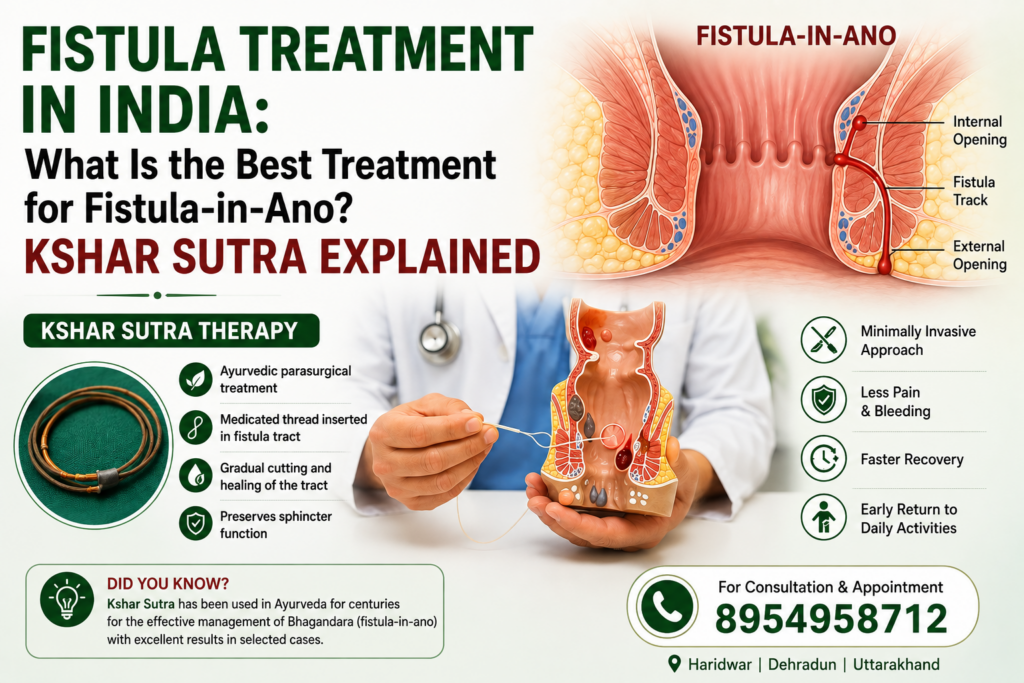
Fistula-in-ano, commonly called an anal fistula or Bhagandara in Ayurveda, is a condition in which an abnormal tract develops between the anal canal and the skin around the anus.
Patients may experience recurrent swelling, pain, pus discharge, itching, irritation or a small opening near the anus. A fistula often develops after an anal abscess has drained, and simply treating the discharge may not eliminate the underlying tract.
One of the most commonly searched questions by patients is:
This is one of the most important questions patients ask.
“What is the best treatment for fistula in India?”
The answer depends on the type, location, length and complexity of the fistula and its relationship with the anal sphincter. Treatment may include fistulotomy, seton-based procedures, sphincter-preserving procedures and, in selected patients, Kshar Sutra therapy.
There is no single treatment that is best for every fistula.
What Is Kshar Sutra Treatment for Fistula?
Kshar Sutra is an Ayurvedic parasurgical technique traditionally used in the management of Bhagandara (fistula-in-ano).
A specially prepared medicated thread is passed through the fistulous tract. The thread is periodically replaced according to the treatment protocol. The aim is gradual cutting and healing of the tract while managing the unhealthy tissue along the fistula pathway.
Clinical research has evaluated Kshar Sutra in fistula-in-ano. A published case series using imaging before and after treatment reported complete healing in the six patients studied, with an average unit cutting/healing time of approximately 7.86 days/cm and no recurrence during 12 months of follow-up. However, this was a small case series, so larger studies are needed to establish general success and recurrence rates.
A prospective study comparing Kshar Sutra with fistulotomy found that Kshar Sutra patients had a longer mean healing time but fewer days away from routine work in that study.
Is Kshar Sutra Better Than Surgery?
Not necessarily for every patient.
The appropriate treatment depends on the anatomy of the fistula.
For a simple, superficial fistula, conventional fistulotomy may be an appropriate option. For fistulas involving a significant amount of sphincter muscle, preserving continence becomes especially important, and other approaches may be considered.
Modern fistula management includes several techniques, and treatment should be selected after assessing the fistula anatomy. International guidelines also recognize that different fistulas require different approaches.
Therefore, instead of asking only:
“Which treatment is the best?”
it is better to ask:
“Which treatment is safest and most appropriate for my type of fistula?”
Why Do Patients Consider Kshar Sutra?
Patients commonly consider Kshar Sutra because it can provide a gradual treatment approach to the fistulous tract.
Potential advantages may include:
- Gradual management of the fistula tract
- Regular follow-up rather than a single definitive operation in selected cases
- Potentially less disruption of routine activities in some patients
- An established Ayurvedic parasurgical approach for Bhagandara
- Can be considered for selected fistula types after proper assessment
However, Kshar Sutra is not a guaranteed cure and is not suitable for every fistula. Complex fistulas, recurrent fistulas, fistulas associated with Crohn’s disease, multiple tracts or significant sphincter involvement require careful assessment and individualized treatment.
Can Fistula Be Treated Without Surgery?
Patients often search for:
“Fistula treatment without surgery”
It is important to understand that an established fistula usually contains a persistent tract. Medicines may help control infection, inflammation or symptoms, but they do not necessarily eliminate the underlying fistulous tract.
Kshar Sutra is sometimes described as a “non-surgical” or “minimally invasive” Ayurvedic treatment, but it is more accurately considered a parasurgical procedure involving placement and periodic changing of a medicated thread.
The goal is to treat the fistulous tract while allowing healing to occur progressively.
How Is Fistula Diagnosed?
Before selecting treatment, the doctor may evaluate:
- External opening of the fistula
- Internal opening
- Length and direction of the tract
- Relationship with the anal sphincter
- Presence of abscess
- Previous fistula operations
- Recurrent disease
- Number of fistulous openings
In selected complex or recurrent cases, imaging such as MRI pelvis with fistula protocol or other appropriate investigations may help define the anatomy.
Correct diagnosis is particularly important before deciding between Kshar Sutra, fistulotomy, seton or sphincter-preserving procedures.
How Long Does Kshar Sutra Treatment Take?
The duration varies considerably from patient to patient.
Factors that can influence treatment duration include:
- Length of the fistula tract
- Type of fistula
- Straight or curved tract
- Fibrosis and chronicity
- Internal opening
- Sphincter involvement
- Previous surgery
- Individual healing response
Published Kshar Sutra research has reported unit cutting/healing times, but these numbers should not be used to predict an individual patient’s exact treatment duration.
Your doctor can give a more meaningful estimate after examining the fistula.
Is Kshar Sutra Painful?
Some patients experience discomfort, pulling sensation, irritation or pain, particularly around the time of thread change.
The amount of discomfort varies according to the fistula, the technique used, individual pain tolerance and the stage of treatment.
It is therefore better to avoid claims such as “100% painless fistula treatment.”
What Happens If Fistula Is Left Untreated?
An anal fistula may remain chronically active and cause:
- Repeated pus discharge
- Recurrent swelling
- Pain
- Abscess formation
- Skin irritation
- Recurrent episodes of infection
- Multiple external openings in some cases
A fistula should therefore be properly evaluated rather than repeatedly treated only with antibiotics or home remedies.
Kshar Sutra Treatment for Fistula – Dr. Vivek Khetwal
Dr. Vivek Khetwal, an Ayurvedic surgeon specializing in Shalya Tantra and anorectal conditions, provides evaluation and treatment guidance for conditions such as fistula-in-ano, piles and fissure.
For patients considering Kshar Sutra, the first step should be a proper assessment of the fistula and determination of whether Kshar Sutra is appropriate for that particular case.
For consultation and information:
Dr. Vivek Khetwal
M.S(Ay) Surgery
📞 Contact: 8954958712
Call or WhatsApp to discuss your symptoms and arrange a consultation.
Frequently Asked Questions About Fistula Treatment
1. What is the best treatment for fistula?
There is no single best treatment for every patient. Treatment depends on fistula anatomy, sphincter involvement, recurrence and complexity. Options can include fistulotomy, seton procedures, sphincter-preserving techniques and Kshar Sutra.
2. Is Kshar Sutra effective for fistula?
Research has reported favorable outcomes with Kshar Sutra in selected patients, but the available evidence varies in quality and size. It should be performed after proper diagnosis and case selection.
3. Can fistula be cured permanently?
Many fistulas can be successfully treated, but recurrence is possible with any treatment. The risk depends on fistula anatomy, correct identification of the internal opening, treatment technique and other patient factors.
4. Is Kshar Sutra safe?
Kshar Sutra can be used safely when appropriately selected and performed by a trained practitioner, with proper follow-up. It is not appropriate for every type of fistula.
5. Can fistula be cured by medicine alone?
Medicines may control infection and symptoms, but an established fistulous tract generally requires definitive treatment rather than repeated medication alone.
6. Is Kshar Sutra an Ayurvedic treatment?
Yes. Kshar Sutra is a traditional Ayurvedic parasurgical technique used particularly for Bhagandara (fistula-in-ano).
7. Which doctor should I consult for fistula?
You should consult a doctor experienced in anorectal disease and fistula management who can assess the fistula anatomy and explain the available treatment options.
Final Takeaway
If you are searching for “best fistula treatment in India,” “Kshar Sutra for fistula,” or “fistula treatment without surgery,” remember that the correct treatment depends on the individual fistula.
Kshar Sutra is an established Ayurvedic parasurgical option for selected cases of fistula-in-ano, but it should not be promoted as the universally best treatment or a guaranteed cure.
A proper examination and, when required, imaging can help determine whether Kshar Sutra or another surgical/sphincter-preserving procedure is more appropriate.
Want to know whether Kshar Sutra may be suitable for your fistula?
Contact Dr. Vivek Khetwal:
📞 8954958712
This article is for educational purposes and does not replace an in-person medical consultation. Treatment should be selected after appropriate clinical assessment.